
What Makes an Object Meaningful?
Most objects enter our lives quietly.
We purchase them, place them within our homes, and move on.
Many are eventually replaced, forgotten, or discarded without much thought.
Yet some objects become something more.
We reach for them repeatedly.
We notice them every day.
Years pass, and they remain.
Not because they are the most expensive or the most practical, but because they have become woven into the fabric of our lives.
They hold meaning.
What is it that transforms an ordinary object into something we genuinely value?
The answer is rarely found in the object alone.
It emerges through a relationship.
Beyond Function
Every object serves a purpose.
A lamp provides light.
A vase holds flowers.
A bowl contains food.
Function is important, but it is rarely the reason we become attached to something.
Meaning often begins where function ends.
It arises through experience.
The lamp that illuminated countless evenings spent reading.
The vessel that sat at the center of family gatherings.
The handmade object gifted during a significant moment in life.
Over time, the object becomes associated with memory.
It becomes a witness.
A quiet participant in the unfolding of everyday life.
The Human Desire for Connection
We are naturally drawn to stories.
Not only stories told through words, but stories embedded within materials, places, and objects.
When we encounter something handmade, we often sense this immediately.
The carved mark left by a tool.
The subtle asymmetry of a form.
The evidence of a hand shaping clay.
These details remind us that another person was present in the making.
The object did not emerge from an anonymous production line. It came into existence through attention, patience, and care.
In a world increasingly shaped by automation and digital experiences, this connection feels increasingly valuable.
The object carries a human story.
And we become part of it.
The Beauty of What Cannot Be Repeated
There is something meaningful about uniqueness.
Not because rarity itself is important, but because uniqueness reflects a fundamental truth about life.
No two moments are identical.
No two sunsets.
No two seasons.
No two people.
The same is true of handmade work.
A pit-fired vessel carries markings that can never be recreated. Smoke, flame, minerals, and atmosphere all contribute to a surface that exists nowhere else.
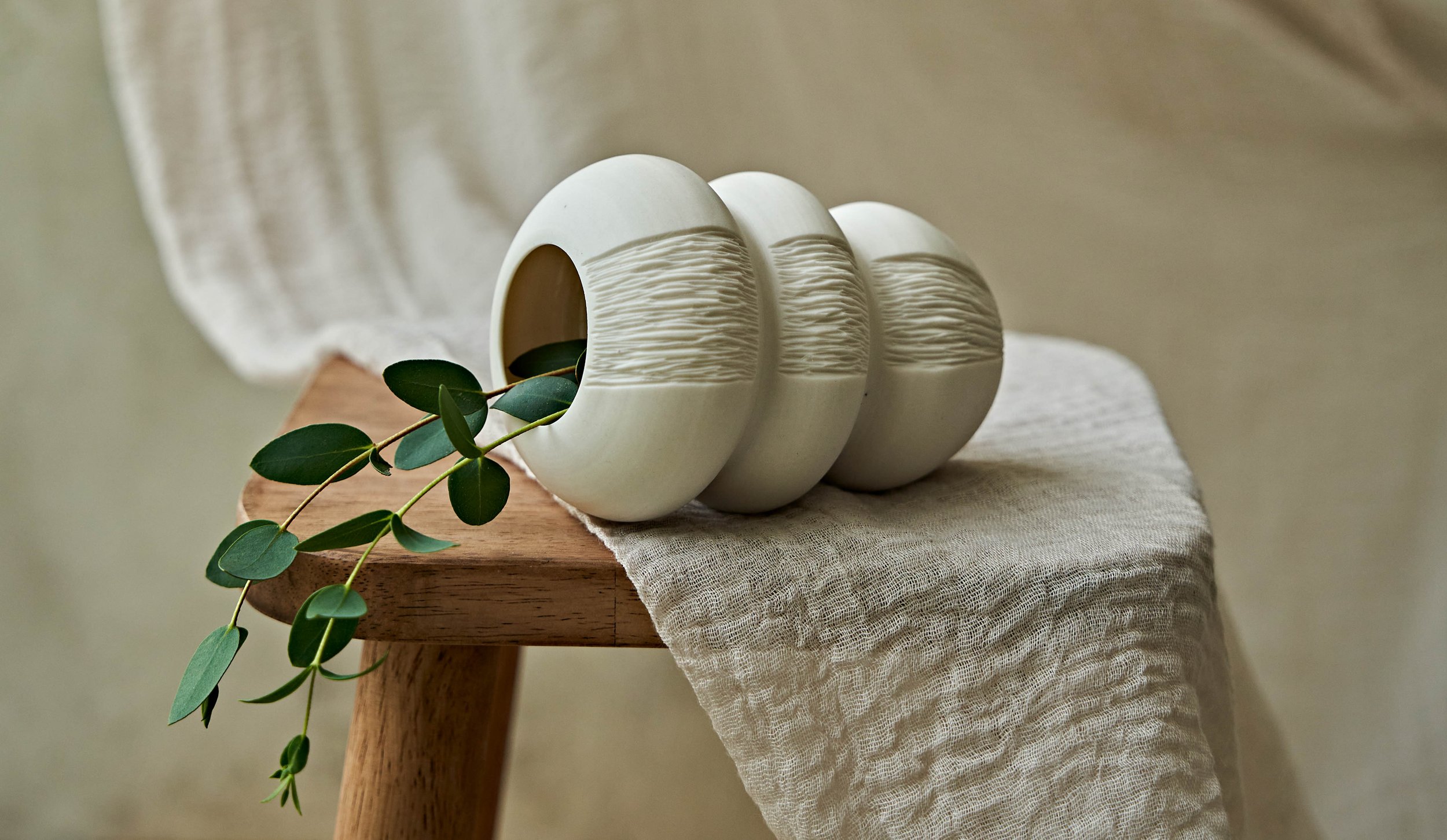
A carved porcelain luminary reveals gestures made by hand that will never occur in precisely the same way again.
These variations remind us that beauty often exists in what cannot be duplicated.
The object becomes a singular expression of a particular moment in time.
Objects That Participate in Ritual
Many meaningful objects become part of daily rituals.
An oil lamp lit at dusk.
A vase refreshed with seasonal branches.
A favorite cup used each morning.
These small acts may seem insignificant, yet they create continuity within our lives.
The object becomes associated with presence.
With routine.
With comfort.
Meaning accumulates gradually through repetition.
Not through grand events, but through ordinary moments experienced again and again.
Living With Natural Materials
The materials we surround ourselves with influence how we experience a space.
Clay.
Wood.
Stone.
Linen.
These materials possess a quality that synthetic alternatives often struggle to replicate. They reveal their origins. They change subtly over time. They carry texture, variation, and evidence of natural processes.
Handmade ceramics are particularly powerful in this regard because they originate from the earth itself.
A vessel shaped from clay.
A lamp transformed by fire.
A surface marked by smoke and minerals.
These materials connect us to something larger than ourselves.
A slower rhythm.
A longer timeline.
A relationship with the natural world.
Meaning Cannot Be Manufactured
Perhaps the most important thing to understand about meaningful objects is that meaning cannot be designed into them.
It cannot be mass-produced.
It cannot be guaranteed.
Meaning emerges through relationship.
Through use.
Through memory.
An object becomes meaningful because it remains present during moments that matter.
Because it accompanies daily rituals.
Because it quietly earns its place within a home.
The Objects We Choose to Keep
At Candere Clay, I often think about the lifespan of the objects I create.
Not simply how they look when they leave the studio, but how they might live within a space years from now.
A lamp illuminating evening conversations.
A porcelain luminary glowing through changing seasons.
A vessel holding branches gathered on a morning walk.
Over time, these objects become more than clay and fire.
They become familiar.
Trusted.
Personal.
And perhaps that is what makes an object meaningful.
Not its rarity.
Not its perfection.
But its ability to participate in the life unfolding around it.
To quietly transform from something we own into something we would never want to be without.
