
Why Carved Porcelain Glows When Illuminated
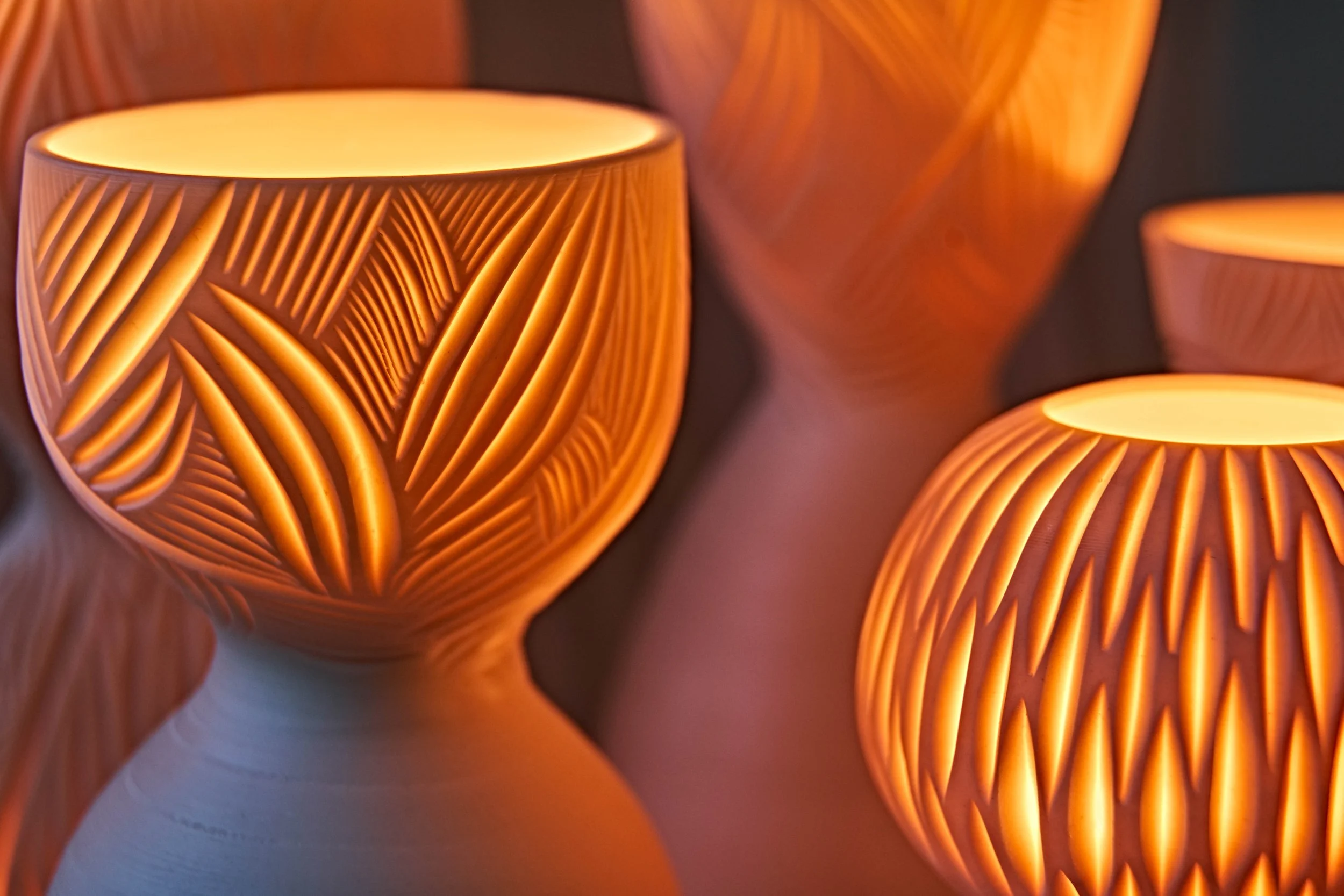
There is a moment each evening when a porcelain luminary transforms.
During the day, it appears solid and quiet, a sculptural object shaped from earth, marked by hand-carved lines and subtle texture. But when illuminated from within, the porcelain begins to glow. Light passes through the clay itself, revealing a warmth and depth that seems almost impossible for a material born from stone.
Many people are surprised to learn that this glow is not simply light escaping through carved openings. The porcelain itself becomes luminous.
The reason lies in the unique nature of certain kinds of porcelain and the remarkable transformation it undergoes in the kiln.
A Clay Made for Light
Porcelain differs from other ceramic bodies in both its composition and the temperatures at which it is fired.
While all clay contains mineral components, porcelain is formulated with a high percentage of refined materials, including kaolin, feldspar, and silica. These ingredients work together during firing to create a ceramic body that is exceptionally dense, strong, and capable of transmitting light.
One of the most important ingredients is silica.
Silica is naturally found in quartz and is a primary component of glass. As porcelain reaches maturation in the kiln (often exceeding 2200°F) the silica and feldspar begin to melt and fuse together. This process creates a glass-like phase within the clay body.
Rather than remaining entirely opaque, the fired porcelain develops a subtle translucency.
Light is able to penetrate the surface, scatter within the material, and emerge as a soft glow.
It is this interaction between light and the vitrified clay body that gives porcelain its distinctive luminous quality.
The Role of Thickness
Not all porcelain glows equally.
The thinner the porcelain wall, the more light can pass through it. This is one of the reasons carved porcelain luminaries create such captivating effects.
As each piece is carved by hand, areas of varying thickness naturally emerge throughout the surface. Some sections remain thicker and more opaque, while others become thin enough to reveal the material's translucency when illuminated.
The result is a landscape of light.
Some areas glow softly. Others appear brighter. The carved marks become illuminated pathways that reveal the movement of the hand that created them.
What appears subtle in daylight becomes dramatically visible after dark.
Light Revealing the Making Process
One of the qualities I love most about porcelain is its ability to reveal what would otherwise remain hidden.
The carving process is entirely intuitive. There are no templates, geometric patterns, or predetermined designs guiding the marks. Instead, each line emerges through a direct conversation between hand, tool, and material.
When illuminated, those gestures become visible in a new way.
The varying depths of each carved line influence how light moves through the porcelain. Tiny differences in thickness create shifts in brightness that cannot be fully predicted or controlled.
The finished piece carries a record of its making.
Light simply reveals it.
A Material That Changes with the Day
Porcelain has long been admired for its ability to exist between opposites.
It is both delicate and durable.
Solid yet translucent.
Quiet in daylight and radiant after dark.
This duality is what continues to draw me to the material.
Each carved porcelain luminary functions as both sculpture and light source. During the day, attention rests on the texture, form, and carved surface. As evening arrives, illumination activates a second layer of the piece, one that exists only through the interaction of clay and light.
The glow is not applied to the surface.
It comes from within.
A transformation made possible by earth, minerals, fire, and the extraordinary translucency of porcelain itself.
