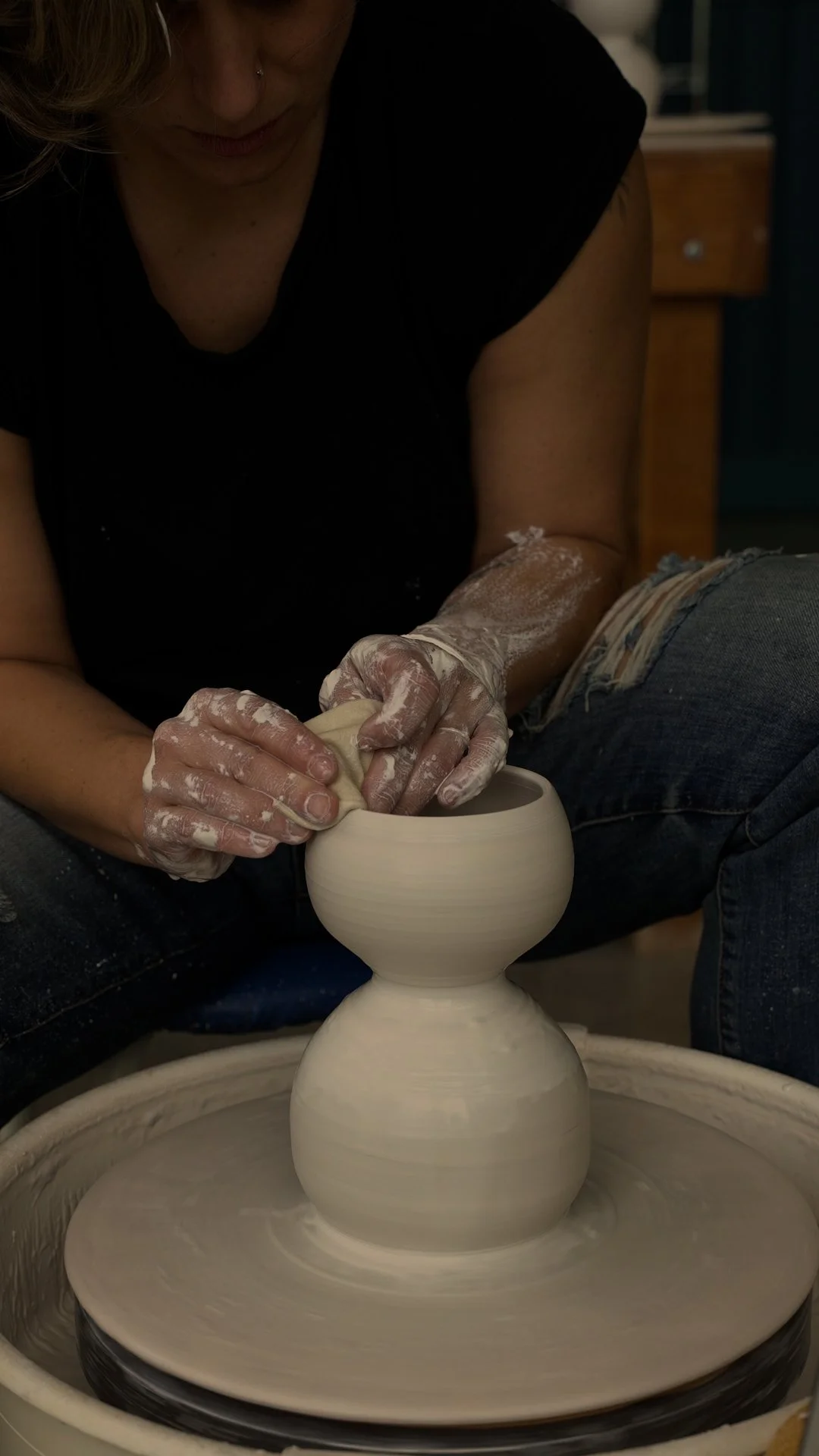
Why I Like to Get My Hands in Clay
We live in a time that asks us to move faster than ever.
There is always another notification.
Another email.
Another headline.
Another thing demanding our attention.
Many of us struggle to watch a two-hour movie without reaching for our phones. Conversations are interrupted by alerts. Moments of stillness are quickly filled with scrolling. The pace of modern life often leaves little room for sustained attention.
And yet, every time I sit down with clay, something different happens.
Everything slows.
Clay Doesn't Care How Busy Your Mind Is
One of the things I love most about working with clay is that it refuses to be rushed.
Clay has its own timeline.
Push too quickly and a wall collapses.
Carve too aggressively and a piece cracks.
Ignore what the material is telling you and it will remind you immediately.
Working with clay requires patience.
Not as an abstract idea, but as a practical necessity.
The material demands presence.
It asks for attention.
It asks for listening.
And in doing so, it offers something increasingly rare in modern life: an opportunity to be completely absorbed in a single moment.
The Practice of Paying Attention
When I am carving a porcelain lamp or shaping a vessel, there is very little room for distraction.
The process requires focus.
The pressure of a carving tool.
The thickness of a wall.
The movement of a line across a curved surface.
Small decisions compound with every gesture.
For a few hours, the noise of the outside world becomes quieter.
The endless stream of information that usually competes for attention begins to fade into the background.
What remains is simply the work.
The clay.
The hands.
The moment.
I think this is part of why making has become so important to me.
Not because it allows me to escape life, but because it allows me to fully enter it.
Learning to Slow Down
Slowing down is often spoken about as though it were a luxury.
For me, it feels more like a discipline.
The natural momentum of modern culture pushes toward speed. Faster communication. Faster production. Faster consumption.
Clay moves in the opposite direction.
It teaches patience through repetition.
A piece must be formed.
Allowed to dry.
Refined.
Fired.
Sometimes fired again.
Days become weeks. Weeks become months.
There are no shortcuts that replace the time required for transformation.
The process continually reminds me that meaningful things often develop slowly.
Not despite the time they require.
Because of it.
Earth in Your Hands
There is also something grounding about working directly with a material that comes from the earth.
Clay connects us to physical reality in a way that screens cannot.
It has weight.
Texture.
Resistance.
It responds to touch.
When my hands are covered in clay, I am reminded that I am participating in something tangible and ancient. The same material that has been used by humans for thousands of years remains just as relevant today.
A handful of earth.
Water.
Fire.
Time.
The simplicity of the process feels increasingly meaningful in a world that often feels abstract and virtual.
Why I Make Handmade Objects
The deeper I move into this work, the less interested I become in creating objects simply for the sake of creating objects.
What interests me is experience.
How a lamp changes the feeling of a room.
How a vessel draws attention to a branch gathered during a morning walk.
How a carved porcelain luminary encourages someone to pause for a moment and simply watch the light.
The pieces I create are born from a process of slowing down.
Of paying attention.
Of being fully present.
My hope is that they carry some of that energy with them into the homes they inhabit.
Not in an obvious way.
But in a quiet one.
Objects That Invite Presence
I often think about what happens after a piece leaves my studio.
A porcelain lamp begins glowing at dusk.
A pit-fired vessel finds a place on a shelf.
An oil lamp becomes part of an evening ritual.
The object enters someone's daily life.
And perhaps, in a small way, it offers an invitation.
To notice the changing light.
To appreciate texture.
To pause before rushing into the next thing.
To be present for a moment longer.
The object itself cannot slow the world down.
But it can remind us that we have the ability to slow ourselves down.
A Different Kind of Value
For me, the value of handmade work has never been about perfection.
It has always been about attention.
Every lamp, vessel, and luminary created at Candere Clay carries hours of focused presence within it. Not because that was the goal, but because the process demanded it.
The clay required it.
And perhaps that is why I continue to return to the studio.
Because in a world that constantly asks us to divide our attention, clay asks for all of it.
It asks me to be here.
Fully.
And in doing so, it reminds me of something I never want to forget:
That a meaningful life is built from moments of presence.
One moment.
One breath.
One handful of clay at a time.